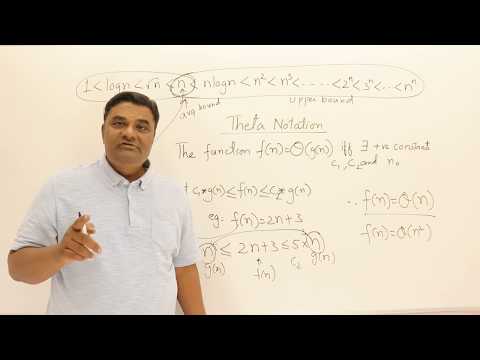
Formal Set-Theoretic Definitions & Relational Analogy
Let $f, g: \mathbb{N} \to \mathbb{R}_{\ge 0}$ be asymptotically non-negative functions. In CLRS notation, each asymptotic symbol defines a set of functions $f(n)$. Although we conventionally write $f(n) = O(g(n))$ as a macro shorthand, its formal mathematical meaning is set membership $f(n) \in O(g(n))$:
- Big-O ($O$, Asymptotic Upper Bound $\approx \le$): $O(g(n)) = \{ f(n) : \exists c > 0, \exists n_0 > 0 \text{ such that } \forall n \ge n_0, 0 \le f(n) \le c \cdot g(n) \}$.
- Big-Omega ($\Omega$, Asymptotic Lower Bound $\approx \ge$): $\Omega(g(n)) = \{ f(n) : \exists c > 0, \exists n_0 > 0 \text{ such that } \forall n \ge n_0, 0 \le c \cdot g(n) \le f(n) \}$.
- Big-Theta ($\Theta$, Asymptotically Tight Bound $\approx =$): $\Theta(g(n)) = O(g(n)) \cap \Omega(g(n))$. By the Transpose Symmetry & Dual Theorem, $f(n) \in \Theta(g(n)) \iff f(n) \in O(g(n)) \text{ and } f(n) \in \Omega(g(n))$.
- Little-o ($o$, Strictly Smaller Growth $\approx <$): Holds for all constants $c > 0$: $o(g(n)) = \{ f(n) : \forall c > 0, \exists n_0 > 0 \text{ such that } \forall n \ge n_0, 0 \le f(n) < c \cdot g(n) \}$. Equivalently, $\lim_{n \to \infty} \frac{f(n)}{g(n)} = 0$.
- Little-omega ($\omega$, Strictly Larger Growth $\approx >$): Holds for all constants $c > 0$: $\omega(g(n)) = \{ f(n) : \forall c > 0, \exists n_0 > 0 \text{ such that } \forall n \ge n_0, 0 \le c \cdot g(n) < f(n) \}$. Equivalently, $\lim_{n \to \infty} \frac{f(n)}{g(n)} = \infty$.
| Notation | Quantifier Structure | Limit Ratio $\lim_{n \to \infty} \frac{f(n)}{g(n)}$ | Real-Number Analogy | Canonical Example |
|---|---|---|---|---|
| $f(n) \in o(g(n))$ | $\forall c > 0, \exists n_0 : f(n) < c g(n)$ | $L = 0$ | $a < b$ | $n \log n \in o(n^{1.01})$ |
| $f(n) \in O(g(n))$ | $\exists c > 0, \exists n_0 : f(n) \le c g(n)$ | $L < \infty$ (if limit exists) | $a \le b$ | $3n^2 + 10n \in O(n^3)$ |
| $f(n) \in \Theta(g(n))$ | $\exists c_1, c_2 > 0, \exists n_0 : c_1 g \le f \le c_2 g$ | $0 < L < \infty$ | $a = b$ | $\log_2(n!) \in \Theta(n \log n)$ |
| $f(n) \in \Omega(g(n))$ | $\exists c > 0, \exists n_0 : f(n) \ge c g(n)$ | $L > 0$ (if limit exists) | $a \ge b$ | $n^2 \in \Omega(n \log n)$ |
| $f(n) \in \omega(g(n))$ | $\forall c > 0, \exists n_0 : f(n) > c g(n)$ | $L = \infty$ | $a > b$ | $2^n \in \omega(n^{100})$ |
Formal Specification: Stirling's Approximation, Harmonic Numbers & Limit Hierarchy
Every algorithm designer must memorize three foundational asymptotic identities and the strict dominance chain:
$$\text{1. Stirling's Factorial Bound:} \quad n! = \sqrt{2\pi n}\left(\frac{n}{e}\right)^n \left(1 + \Theta\left(\frac{1}{n}\right)\right) \implies \ln(n!) = n \ln n - n + \Theta(\ln n) = \Theta(n \log n)$$
$$\text{2. Harmonic Series:} \quad H_n = \sum_{k=1}^{n} \frac{1}{k} = \ln n + \gamma + \Theta\left(\frac{1}{n}\right) = \Theta(\log n), \quad \text{where } \gamma \approx 0.57721566$$
$$\text{3. Polylog vs Polynomial vs Exponential:} \quad (\log n)^k \in o(n^\epsilon) \quad \text{and} \quad n^k \in o((1 + \epsilon)^n) \quad \forall k > 0, \forall \epsilon > 0$$
Visualizing the Asymptotic Sandwich $\Theta(g(n))$ & Threshold $n_0$
Below $n_0$, lower-order terms and startup overheads allow $f(n)$ to cross wildly above or below $c_1 g(n)$ and $c_2 g(n)$. Once $n \ge n_0$, $f(n)$ is permanently trapped inside the cone $[c_1 g(n), c_2 g(n)]$.
Hardware Reality: Galactic Algorithms & Hidden Constant Crossover Points ($n_0$)
Because asymptotic notation discards constant factors $c$ and threshold $n_0$, an algorithm with superior asymptotic complexity can be unusable on physical computers—a class Richard Lipton termed Galactic Algorithms. For example, matrix multiplication via the Coppersmith-Winograd / Alman-Williams tensor laser method runs in $O(n^{2.371552})$, beating Strassen's $O(n^{\log_2 7}) \approx O(n^{2.8074})$ and naive $O(n^3)$. Yet the hidden constant $c$ of the $O(n^{2.371552})$ algorithm is so astronomical that $n_0$ exceeds the number of atoms in the observable universe. Conversely, even Strassen's algorithm only beats cache-tiled AVX-512 $O(n^3)$ GEMM for $n \ge 1024$ due to memory allocation overhead.
Proving Asymptotic Relationships & Exposing Fallacies
Two mathematical pitfalls routinely trap engineers during complexity proofs:
- Failure of Trichotomy: For real numbers $a, b$, exactly one of $a < b$, $a = b$, or $a > b$ holds. For functions, trichotomy fails! Consider $f(n) = n^{1 + \sin n}$, which oscillates infinitely between $1$ and $n^2$. Compared to $g(n) = n$, the ratio $f(n)/g(n) = n^{\sin n}$ has $\limsup = \infty$ and $\liminf = 0$, so $f(n)$ is neither $O(n)$ nor $\Omega(n)$.
- One-Way Macro Equations & Unbounded Summations: In an equation like $2n^2 + 3n + 1 = 2n^2 + \Theta(n)$, any anonymous $\Theta(n)$ on the left-hand side can be absorbed into an anonymous $\Theta(n^2)$ on the right-hand side, never the reverse. Moreover, you cannot apply $\sum_{i=1}^{n} O(i) = O(n) \cdot O(n)$ blindly when the number of terms depends on $n$—you must sum the underlying series $\sum_{i=1}^{n} c \cdot i = c \frac{n(n+1)}{2} = \Theta(n^2)$ before taking the asymptotic class.
// C++20: Empirical Crossover Verification & Exact Harmonic / Stirling Asymptotic Bounds
#include <cmath>
#include <cstdint>
#include <numbers>

// Computes ln(n!) in O(1) time with relative error < 1/(12n) via Stirling's series:
// ln(n!) = n*ln(n) - n + 0.5*ln(2*pi*n) + 1/(12n) - 1/(360n^3) + O(1/n^5)
double stirlingLogFactorial(uint64_t n) noexcept {
    if (n <= 1) return 0.0;
    const double dn = static_cast<double>(n);
    const double invN = 1.0 / dn;
    return dn * std::log(dn) - dn
           + 0.5 * std::log(2.0 * std::numbers::pi * dn)
           + (invN / 12.0) * (1.0 - (invN * invN) / 30.0);
}

// Demonstrates why Sum_{i=1..n} floor(n / i) = Theta(n log n) (Sieve / Divisor Lattice)
uint64_t divisorLatticeWork(uint64_t n) noexcept {
    uint64_t ops = 0;
    for (uint64_t step = 1; step <= n; ++step) {
        for (uint64_t multiple = step; multiple <= n; multiple += step) {
            ++ops; // Executes floor(n / step) times; total = n * H_n = Theta(n log n)
        }
    }
    return ops;
}Compare per-level work a^d · f(n/b^d) across Balanced Case 2 (Merge Sort), Leaf-Heavy Case 1 (Karatsuba/Strassen), and uneven Akra-Bazzi T(n) = T(n/3) + T(2n/3) + Θ(n).
Invariant & State
Failure Modes & Adversarial Pitfalls
- Exponentiating Asymptotic Bounds Is Invalid: Knowing $f(n) = \Theta(n)$ does NOT imply $2^{f(n)} = \Theta(2^n)$! Counterexample: let $f(n) = 2n \in \Theta(n)$. Then $2^{f(n)} = 2^{2n} = 4^n = \omega(2^n)$, because $\lim_{n \to \infty} 4^n / 2^n = \lim 2^n = \infty$. Specifically, $2^{n + O(1)} = \Theta(2^n)$, whereas $2^{O(n)}$ has a variable exponent base.
- Conflating Pseudo-Polynomial Time with Polynomial Time: In problems with numeric input $W$ (like 0/1 Knapsack $O(N \cdot W)$ or primality testing $O(\sqrt{W})$), the input size in bits is $b = \lfloor \log_2 W \rfloor + 1$. Thus $W = 2^{b-1}$, making $O(N \cdot W) = O(N \cdot 2^b)$ strictly exponential in the bit-length of the input!