1. The Choice–Constraint–Undo Architecture & Knuth's Monte Carlo Tree Size Estimator
Every backtracking solver traverses an implicit state-space tree of depth $d$. If the branching factor at depth $k$ is $b_k$, a naive exhaustive search visits $\prod_{k=0}^{d-1} b_k$ leaves. Pruning predicates $P(s)$ cut off invalid partial states at depth $k$, eliminating the entire subtree of size $\prod_{j=k}^{d-1} b_j$ beneath them.
Core Invariant — Exact State Restoration (The Undo Contract)
Let $\Sigma$ be the mutable solver state before branching on choice $c$ at depth $k$. After executing apply(c), invoking dfs(k + 1), and executing undo(c), the bitwise representation of $\Sigma$ must be identical to its pre-branch value. Any side effect that escapes undo(c) (such as a modified helper array or un-cleared bitmask) corrupts sibling subtrees.
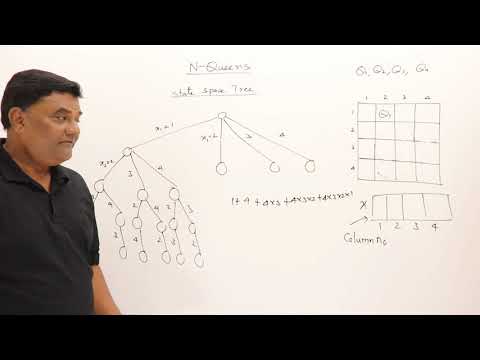
How do we know whether a backtracking search will finish in 10 milliseconds or 10 years? Knuth's Random Walk Estimator (1975) samples random root-to-leaf paths: at depth $k$, if there are $d_k$ valid children, pick one uniformly at random. The quantity $X = 1 + d_0 + d_0 d_1 + d_0 d_1 d_2 + \dots$ is an unbiased estimator ($\mathbb{E}[X] = |T|$) of the exact number of nodes in the pruned state-space tree!
2. Variable Ordering (MRV) & Symmetry-Breaking Pruning
Two orthogonal techniques routinely compress a $10^{15}$-node search tree into $10^4$ nodes:
- Fail-First / Minimum Remaining Values (MRV): When choosing which variable (e.g., Sudoku cell or graph vertex) to assign next, always pick the unassigned variable with the fewest legal choices remaining. If a variable has $0$ legal choices, we backtrack immediately ($b_k = 0$); if it has $1$ choice, we avoid branching ($b_k = 1$). Minimizing $b_k$ near the root shrinks the multiplier on all deeper levels.
- Symmetry Breaking (Canonical Ordering):
- Duplicate Elements (Subsets II / Permutations II): Sort the array first, and at the same recursion depth skip index $i$ if
A[i] == A[i-1]and $i-1$ was not taken in the current step. - Identical Bins (Partition into $K$ Equal-Sum Subsets): Never try placing an item into a second empty bin if placing it into the first empty bin failed—all empty bins are symmetric! Furthermore, sort items in descending order so large items fail early.
- Rotational/Reflective Symmetry (N-Queens): Restrict the first row's queen to columns $0 \dots \lfloor N/2 \rfloor - 1$ and double the count (handling the center column when $N$ is odd).
- Duplicate Elements (Subsets II / Permutations II): Sort the array first, and at the same recursion depth skip index $i$ if
Step through O(1) bitmask attack propagation (cols, ld, rd) for N-Queens, Knuth Algorithm X circular doubly-linked cover/uncover, and Meet-in-the-Middle subset search.
Invariant & State
Bins: [0, 0, 0]"] --> B0["Try Bin 0: [7, 0, 0]
Explore Subtree... (Fails)"] Root -. "PRUNED by Symmetry:
Bin 1 == Bin 0 == 0" .-> B1["Try Bin 1: [0, 7, 0]
Identical State!"] Root -. "PRUNED by Symmetry:
Bin 2 == Bin 0 == 0" .-> B2["Try Bin 2: [0, 0, 7]
Identical State!"]
Hardware Reality — Bitmask State Representation for Zero-Undo Overhead
In the classic $N$-Queens problem ($N \le 32$), storing board attacks in a 2D boolean array requires $O(N)$ memory reads per conflict check. Instead, pass three 32-bit integers by value down the recursion stack: cols, diag1 (shifted left each row), and diag2 (shifted right each row). Available safe columns in the current row are computed in 1 cycle via avail = ((1U << n) - 1) & ~(cols | diag1 | diag2), iterated via bit = avail & -avail, and because the masks are passed in CPU registers by value, undo costs 0 instructions upon function return!
3. Complexity Matrix
| Problem & Strategy | Unpruned Search Space | Pruned Worst-Case Time | State Stack Space | Conflict Check Cost |
|---|---|---|---|---|
| $N$-Queens (Naive $N^2$ Cell Placement) | O(C(N^2, N)) | O(N!) | O(N^2) | O(N) |
| $N$-Queens (Row-by-Row Bitmask Backtracking) | O(N^N) | O(N!) | O(N) | O(1) |
| $K$-Partition Equal Subsets (With Empty-Bin Symmetry) | O(K^N) | O(K^N / K!) | O(N + K) | O(1) |
| Sudoku $9 \times 9$ (Bitmask + MRV Cell Selection) | O(9^81) | ~10^2 - 10^4 nodes | O(81) | O(1) |
4. Reference C++20 Implementation
#include <algorithm>
#include <cstdint>
#include <numeric>
#include <vector>

// 1. Ultra-Fast Bitmask N-Queens Solver (Zero-allocation, O(1) conflict & undo)
long long solve_n_queens_bitmask(int n) {
    const std::uint32_t all_cols = (1U << n) - 1U;
    auto dfs = [&](auto& self, std::uint32_t cols, std::uint32_t diag1, std::uint32_t diag2) -> long long {
        if (cols == all_cols) return 1LL; // All N rows placed
        long long count = 0;
        std::uint32_t avail = all_cols & ~(cols | diag1 | diag2);
        while (avail) {
            std::uint32_t bit = avail & -avail; // Isolate lowest available column
            avail -= bit;                       // Clear lowest bit (BLSR)
            count += self(self, cols | bit, (diag1 | bit) << 1, (diag2 | bit) >> 1);
        }
        return count;
    };
    return dfs(dfs, 0U, 0U, 0U);
}

// 2. Partition Array into K Equal-Sum Subsets with Symmetry Breaking + Fail-First Sorting
bool can_partition_k_subsets(std::vector<int> nums, int k) {
    long long total = std::accumulate(nums.begin(), nums.end(), 0LL);
    if (total % k != 0) return false;
    const int target = static_cast<int>(total / k);

    // Fail-first heuristic: sort descending so large items trigger pruning at the root
    std::sort(nums.begin(), nums.end(), std::greater<int>());
    if (nums[0] > target) return false;

    std::vector<int> bins(k, 0);
    const int n = static_cast<int>(nums.size());

    auto dfs = [&](auto& self, int idx) -> bool {
        if (idx == n) return true;
        const int val = nums[idx];
        for (int b = 0; b < k; ++b) {
            if (bins[b] + val > target) continue;
            // Symmetry Breaking 1: Skip duplicate bin loads at the same level
            if (b > 0 && bins[b] == bins[b - 1]) continue;

            bins[b] += val;                  // CHOICE
            if (self(self, idx + 1)) return true;
            bins[b] -= val;                  // UNDO

            // Symmetry Breaking 2: If placing val into an empty bin failed,
            // it can never succeed in any other empty bin.
            if (bins[b] == 0) break;
        }
        return false;
    };
    return dfs(dfs, 0);
}
Production Pitfall — Pruning Inside the Base Case Instead of Before Recursing
Checking validity at the entry of dfs(depth + 1) instead of inside the loop before calling dfs multiplies the number of function call frames by the branching factor $b$—often up to $9\times$ or $N\times$ more leaf invocations. Always test feasibility before pushing a stack frame, and when using MRV (dynamic variable ordering), remember to restore the chosen cell's state before returning if no choice succeeded.