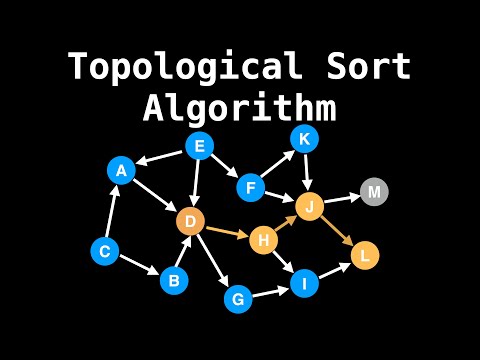
Mathematical Duality: Source Peeling vs. Finish-Time Ordering
A directed graph $G = (V, E)$ admits a topological ordering if and only if $G$ is a DAG (contains no directed cycles). Both standard algorithms exploit complementary structural invariants of DAGs.
Theorem (CLRS Theorem 20.11): A directed graph $G$ is acyclic if and only if a DFS of $G$ yields no back edges. Furthermore, for every directed edge $(u, v) \in E$ in a DAG:
$$\text{tout}[u] > \text{tout}[v]$$Proof: When edge $(u, v)$ is explored from $u$, $v$ cannot be GRAY (otherwise $(u, v)$ would be a back edge, contradicting acyclicity). If $v$ is WHITE, DFS recurses on $v$ and finishes $v$ before finishing $u$, so $\text{tout}[v] < \text{tout}[u]$. If $v$ is already BLACK, $v$ finished before $u$ even finished, so $\text{tout}[v] < \text{tout}[u]$. Ordering vertices in decreasing order of $\text{tout}$ therefore places $u$ before $v$ for every edge $(u, v)$.
1. Kahn's Algorithm (1962): Indegree Peeling & Cycle Detection
Every non-empty finite DAG has at least one vertex with $\text{indegree}(u) = 0$ (otherwise walking backward along incoming edges would repeat a vertex in $\le |V|$ steps, forming a cycle). Kahn's algorithm maintains an array $\text{in}[0 \dots V-1]$ and a ready queue $Q$ of all vertices with $\text{in}[u] == 0$:
- Pop $u$ from $Q$ and append $u$ to the topological order.
- For each outgoing edge $(u, v)$, decrement $\text{in}[v]$. If $\text{in}[v]$ reaches $0$, push $v$ into $Q$.
- Built-in Cycle Verification: If the loop terminates and the output list has fewer than $|V|$ vertices, the remaining vertices with $\text{in}[w] > 0$ contain at least one directed cycle (and everything reachable only from those cycles).
2. Lexicographically Smallest Topological Sort & Parallel Layering
Kahn's algorithm offers two capabilities that DFS post-order reversal cannot match directly:
- Lexicographically Smallest Topological Order: Replace the FIFO queue $Q$ in Kahn's algorithm with a min-heap (
std::priority_queue<int, vector<int>, greater<int>>). At every step, among all currently unconstrained tasks ($ ext{in}[u] = 0$), picking the minimum index $u$ greedily produces the lexicographically smallest valid topological sequence in $O((V + E) \log V)$. (Note: sorting adjacency lists in DFS does not produce the lexicographically smallest topological sort!). - Parallel Execution Waves (Level-by-Level Kahn): Processing all current zero-indegree vertices in batch waves yields the minimum number of parallel stages needed to execute a task graph with infinite processors—equal to the longest path in the DAG.
Peel indegree-0 vertices with Kahn’s queue while relaxing longest-path DAG DP, detect unpeeled cyclic cores in Bazel/Cargo build graphs, or solve 2-SAT via implication graph (¬a → b) SCC topological order.
Invariant & State
In Kahn's algorithm, the output vector order itself can act as the FIFO queue: push initial zero-indegree nodes into order, maintain a read index readIdx = 0, and loop while readIdx < order.size(), appending newly unlocked zero-indegree neighbors directly to the back of order. This eliminates a separate std::queue allocation and performs strictly sequential writes and reads in a single contiguous vector.
Complexity Matrix
| Algorithm | Time Complexity | Auxiliary Space | Cycle Detection | Lexicographical Order |
|---|---|---|---|---|
| Kahn's Algorithm (FIFO Queue) | O(V + E) | O(V) | order.size() < V |
No (wave order) |
| Kahn's Algorithm (Min-Heap) | O((V + E) log V) | O(V) | order.size() < V |
Yes (exact global min) |
| DFS Post-Order Reversal | O(V + E) | O(V) | Requires 3-color GRAY check | No |
Production Implementation: Zero-Allocation In-Place Kahn's Algorithm
#include <vector>
#include <queue>

// Returns topological order of size V, or an empty vector if G contains a directed cycle.
std::vector<int> topologicalSortKahn(int n, const std::vector<std::vector<int>>& adj) {
    std::vector<int> indegree(n, 0);
    for (int u = 0; u < n; ++u) {
        for (int v : adj[u]) {
            ++indegree[v];
        }
    }

    // Use the output vector itself as the FIFO queue (zero secondary queue allocation)
    std::vector<int> order;
    order.reserve(n);
    for (int u = 0; u < n; ++u) {
        if (indegree[u] == 0) {
            order.push_back(u);
        }
    }

    for (size_t readIdx = 0; readIdx < order.size(); ++readIdx) {
        int u = order[readIdx];
        for (int v : adj[u]) {
            if (--indegree[v] == 0) {
                order.push_back(v);
            }
        }
    }

    if (static_cast<int>(order.size()) != n) {
        return {}; // Directed cycle exists
    }
    return order;
}A frequent bug is running a simple 2-state (visited[u] boolean) DFS that appends $u$ on post-order and reverses the result, assuming the input graph is a DAG. On a graph with a cycle, a 2-state DFS still returns a permutation of length $|V|$ without throwing an error! If using DFS for topological sort on untrusted graphs, you must maintain 3 colors (WHITE/GRAY/BLACK) and abort if any edge targets a GRAY vertex.