Input Space vs Auxiliary Space & Stack Frame Reuse
Let an algorithm accept an input of size $N$. Its memory footprint is partitioned into three distinct regions:
- Input Space: The memory occupied by the input parameters themselves. An in-place algorithm (strictly defined as $O(1)$ auxiliary space, or loosely in sorting as $O(\log N)$ auxiliary stack space) mutates the input buffer directly without allocating a proportional copy.
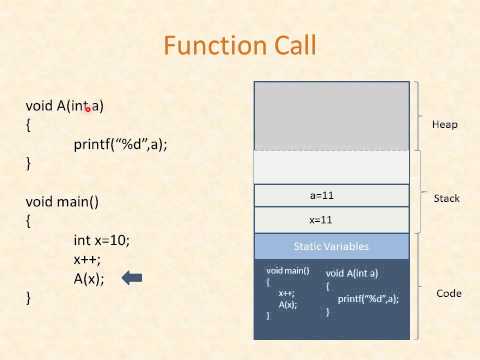
- Auxiliary Call-Stack Space: On x86-64 System V ABI, every
callinstruction pushes an 8-byte return instruction pointer (%rip), saves the caller's frame pointer (%rbp) and any modified callee-saved registers (%rbx,%r12–%r15), allocates local variables, and pads the stack pointer (%rsp) to a 16-byte alignment boundary. Consequently, even a function with a singleintparameter consumes 32 to 64 bytes per stack frame. - Auxiliary Heap Space: Dynamic allocations (
malloc,new,std::vector) reside in the process heap. Every heap allocation carries an 8–16 byte allocator metadata header (size_tchunk size + flags injemalloc/ptmalloc) and rounds up to size-class bins (16B, 32B, 48B, 64B).
| Algorithm / Implementation | Time Complexity | Auxiliary Stack Space | Auxiliary Heap Space | Stack Overflow Risk ($N = 10^6$)? |
|---|---|---|---|---|
Recursive Fibonacci fib(n-1) + fib(n-2) |
$\Theta(\phi^n)$ | $\Theta(n)$ frames | $O(1)$ | Stack depth is $n$, NOT $2^n$ (frames reuse slots!) |
| Standard Top-Down Mergesort | $\Theta(N \log N)$ | $\Theta(\log N)$ frames | $\Theta(N)$ buffer | Safe (~20 frames $\approx 1\text{ KB}$ stack) |
| Naive Recursive Quicksort (Skewed Pivot) | $\Theta(N^2)$ worst | $\Theta(N)$ worst | $O(1)$ | CRASH! $10^6 \times 48\text{ B} \approx 48\text{ MB} > 8\text{ MB}$ ulimit |
| Hoare / Sedgewick Tail-Call Quicksort | $\Theta(N^2)$ worst | $\Theta(\log N)$ strict | $O(1)$ | Safe! Recurses only on smaller partition ($\le N/2$) |
Formal Specification: Tail-Call Optimization (TCO) & Smaller-Half Recursion
A recursive call is in tail position if it is the absolute final action performed by the function before returning—meaning no post-call addition, multiplication, or local destructor (RAII) runs after the callee returns. Under Tail-Call Optimization (TCO), the compiler overwrites the current activation record's parameters in-place and emits an unconditional jump (jmp) instead of a call instruction, reducing $\Theta(N)$ recursion depth to strict $O(1)$ stack space.
Sedgewick's Smaller-Half Invariant (Bounding Quicksort Stack to $\le \log_2 N$): Quicksort makes two recursive calls: quicksort(lo, p - 1) and quicksort(p + 1, hi). Only the second call is in tail position. If we always recurse on the smaller partition first and loop (tail-eliminate) on the larger partition, every true stack frame pushed cuts the problem size by at least half ($n_{k+1} \le \lfloor n_k / 2 \rfloor$), guaranteeing worst-case stack depth $\le \lfloor \log_2 N \rfloor$ even when pivots are 100% adversarial!
Visualizing x86-64 Stack Frame Layout & Tail-Call Frame Overwrite
The diagram below compares standard non-tail recursion (which grows downward in memory by 48 bytes per call toward the guard page) against Tail-Call Elimination (which mutates arguments inside the existing frame and jumps to the function prologue).
Step through push(x) operations as capacity doubles (1 → 2 → 4 → 8 → 16). Watch Tarjan’s potential function Φ = 2n − m bank 2 credits on cheap inserts to pay for O(n) reallocation copies.
Invariant & State
m = 1 | Size n = 1 | Load Factor α = 100%
Hardware Reality: Linux $8\text{ MB}$ vs Windows $1\text{ MB}$ vs Coroutine/Fiber $64\text{ KB}$ Stacks
Default main-thread stack sizes vary dramatically across operating systems and runtimes: Linux ulimit -s defaults to 8 MB, Windows PE executables default to 1 MB, Java/JVM threads default to 1 MB, Python limits recursion depth to 1,000 frames, and modern C++20 stackful fibers / Rust async worker threads often run on 64 KB to 256 KB stacks. A recursive DFS over a graph or tree of $N = 50{,}000$ vertices passes every unit test on a developer's macOS/Linux laptop, then immediately crashes in production inside a containerized microservice thread pool or Windows client.
Production Pattern: Sedgewick's $O(\log N)$-Stack Quicksort
The C++20 implementation below demonstrates how to guarantee $O(\log N)$ worst-case stack space in Quicksort by recursing strictly on the smaller partition and converting the larger partition into an iterative while loop.
// C++20: Sedgewick's Smaller-Half Tail-Eliminated Quicksort (Strict O(log N) Auxiliary Stack)
#include <algorithm>
#include <cstddef>
#include <span>

ptrdiff_t hoarePartition(std::span<int64_t> a, ptrdiff_t lo, ptrdiff_t hi) noexcept {
    int64_t pivot = a[lo + (hi - lo) / 2];
    ptrdiff_t i = lo - 1;
    ptrdiff_t j = hi + 1;
    while (true) {
        do { ++i; } while (a[i] < pivot);
        do { --j; } while (a[j] > pivot);
        if (i >= j) return j;
        std::swap(a[i], a[j]);
    }
}

// Guaranteed <= log2(N) stack frames even on 100% adversarial inputs!
void safeQuicksort(std::span<int64_t> a, ptrdiff_t lo, ptrdiff_t hi) noexcept {
    while (lo < hi) {
        ptrdiff_t p = hoarePartition(a, lo, hi);
        // Recurse ONLY on the smaller half (at most half the current range);
        // handle the larger half via the enclosing while-loop (Tail-Call Elimination).
        if (p - lo < hi - (p + 1)) {
            safeQuicksort(a, lo, p);
            lo = p + 1; // Tail-call eliminated!
        } else {
            safeQuicksort(a, p + 1, hi);
            hi = p;     // Tail-call eliminated!
        }
    }
}
Failure Modes & Adversarial Pitfalls
- RAII Destructors Silently Disabling C++ Tail-Call Optimization: If a C++ function declares a local
std::vector,std::string, orstd::unique_ptron the stack, its destructor~T()must execute after the recursive call returns. Consequently, the recursive call is no longer in tail position, and-O3cannot eliminate the stack frame! - Allocating Scratch Buffers Inside Recursive Calls: Writing
std::vector<int> temp(n);insidemergeSort(a, lo, hi)and freeing it after merging still uses $\Theta(N)$ peak memory ($N + N/2 + N/4 + \dots = 2N$), but invokes the OS heap allocator $2N$ times instead of $1$ time. Always pre-allocate a single scratch buffer of size $N$ at the top-level entry point and pass slices (std::span) down the recursion tree.