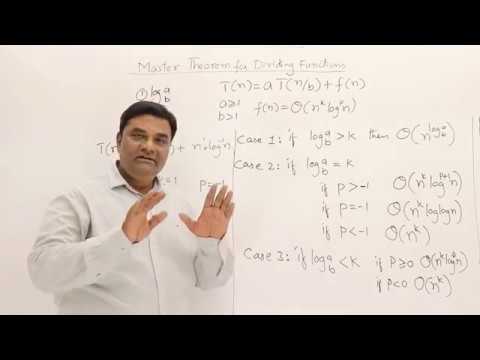
The Recursion Tree Geometric Series & The Watershed Function $n^{\log_b a}$
Consider the recurrence $T(n) = a\,T(n/b) + f(n)$ where $a \ge 1$ and $b > 1$ are constants. At depth $j$ of the recursion tree ($0 \le j \le \log_b n$), there are $a^j$ nodes, each solving a subproblem of size $n / b^j$ and performing $f(n / b^j)$ local work. Summing across all levels gives the exact total runtime:
$$T(n) = \Theta\left(n^{\log_b a}\right) + \sum_{j=0}^{\log_b n - 1} a^j f\left(\frac{n}{b^j}\right)$$
Here, the number of leaves at the bottom of the tree is $a^{\log_b n} = n^{\log_b a}$ (by the logarithmic identity $a^{\log_b n} = (b^{\log_b a})^{\log_b n} = n^{\log_b a}$). We call $n^{\log_b a}$ the watershed function. Comparing $f(n)$ to $n^{\log_b a}$ yields the three regimes of the Master Theorem (including the generalized polylogarithmic Case 2):
| Master Regime | Condition on $f(n)$ vs Watershed $n^{\log_b a}$ | Closed-Form Solution $T(n)$ | Work Distribution Across Tree | Classic Algorithm |
|---|---|---|---|---|
| Case 1 (Leaf-Heavy) | $f(n) = O(n^{\log_b a - \epsilon})$ for some $\epsilon > 0$ | $\Theta(n^{\log_b a})$ | Geometrically increasing down tree; leaves dominate | Strassen $7T(n/2) + \Theta(n^2) \implies \Theta(n^{\log_2 7})$ |
| Case 2 (Balanced Levels) | $f(n) = \Theta(n^{\log_b a} \log^k n)$ for $k \ge 0$ | $\Theta(n^{\log_b a} \log^{k+1} n)$ | Every level performs equal work $\Theta(n^{\log_b a} \log^k n)$ | Mergesort $2T(n/2) + \Theta(n) \implies \Theta(n \log n)$ |
| Case 2b ($k = -1$ Border) | $f(n) = \Theta(n^{\log_b a} / \log n)$ ($k = -1$) | $\Theta(n^{\log_b a} \log \log n)$ | Harmonic decay across $\log_b n$ levels ($\sum 1/j$) | $2T(n/2) + \Theta(n / \log n) \implies \Theta(n \log \log n)$ |
| Case 3 (Root-Heavy) | $f(n) = \Omega(n^{\log_b a + \epsilon})$ & $a f(n/b) \le c f(n)$ ($c < 1$) | $\Theta(f(n))$ | Geometrically decreasing down tree; root dominates | Quickselect Avg $T(n/2) + \Theta(n) \implies \Theta(n)$ |
Formal Specification: Polynomial Gap Requirement & The Substitution Method
In Case 1 and Case 3, $f(n)$ must be polynomially smaller or larger than $n^{\log_b a}$ by a factor of $n^{\pm \epsilon}$ for some constant $\epsilon > 0$. If $f(n) = n^{\log_b a} / \log n$, the ratio is $\log n = o(n^\epsilon)$ for every $\epsilon > 0$—falling into the chasm between Case 1 and Standard Case 2 (resolved by generalized Case 2 with $k = -1$). Furthermore, Case 3 requires the Regularity Condition: $\exists c < 1$ such that $a f(n/b) \le c f(n)$ for all $n \ge n_0$.
Strengthening the Inductive Hypothesis (Substitution Method): Suppose $T(n) = 2T(n/2) + 1$ and we want to prove $T(n) \le c n$. Substituting the inductive hypothesis gives $T(n) \le 2(c n / 2) + 1 = c n + 1$, which fails to prove $T(n) \le c n$! To make induction succeed, we must subtract a lower-order term: hypothesize $T(n) \le c n - d$. Then $T(n) \le 2(c(n/2) - d) + 1 = c n - 2d + 1 \le c n - d$ for all $d \ge 1$.
Visualizing the Three Master Theorem Work Profiles
The SVG diagram below contrasts the per-level work across depth $j \in [0, \log_b n]$ for Case 1 (expanding geometric series), Case 2 (constant rectangular column), and Case 3 (contracting geometric series).
Hardware Reality: Recursion Tree Base-Case Coarsening ($n_{\text{leaf}} = 32\text{–}64$)
In a naive recursive implementation of Mergesort or Strassen's algorithm that recurses all the way down to $n = 1$, Case 1 and Case 2 show that the recursion tree generates $\Theta(n^{\log_b a})$ leaves. In fact, in a binary recursion tree ($a = 2, b = 2$), 50% of all recursive function calls occur at the very bottom leaf level ($n = 1$), and 75% occur in the bottom two levels! If you coarsen the base case to switch to an in-place iterative kernel (like Insertion Sort for Mergesort or an AVX-512 register micro-kernel for GEMM) at $n_{\text{base}} = 32$, you prune the bottom $\log_2 32 = 5$ levels of the recursion tree, eliminating $96.875\%$ ($31/32$) of all function call frames while keeping each leaf tile completely inside L1 cache.
Change of Variables for Non-Linear Recurrences
Some recurrences do not shrink by a constant divisor $n/b$, such as $T(n) = 2T(\sqrt{n}) + \log_2 n$ (which arises in van Emde Boas trees). By substituting $m = \log_2 n$ (so $n = 2^m$ and $\sqrt{n} = 2^{m/2}$) and defining $S(m) = T(2^m)$, the recurrence transforms into a standard Master Theorem form:
$$S(m) = 2S(m/2) + m \implies S(m) = \Theta(m \log m) \implies T(n) = \Theta(\log n \log \log n)$$
// C++20: Coarsened Divide-and-Conquer with L1-Cache Base Case (Eliminating 97% of Call Frames)
#include <algorithm>
#include <cstddef>
#include <span>

// Base case threshold: 32 int64_t elements = 256 bytes (4 L1 cache lines)
constexpr size_t kLeafThreshold = 32;

void insertionSortBase(std::span<int64_t> a) noexcept {
    for (size_t i = 1; i < a.size(); ++i) {
        int64_t key = a[i];
        size_t j = i;
        while (j > 0 && a[j - 1] > key) {
            a[j] = a[j - 1];
            --j;
        }
        a[j] = key;
    }
}

// Recurrence: T(n) = 2 T(n/2) + Theta(n), pruned at n <= 32
void coarsenedMergeSort(std::span<int64_t> a, std::span<int64_t> scratch) noexcept {
    const size_t n = a.size();
    if (n <= kLeafThreshold) {
        insertionSortBase(a); // Prunes bottom 5 levels of recursion tree!
        return;
    }
    const size_t mid = n / 2;
    coarsenedMergeSort(a.first(mid), scratch.first(mid));
    coarsenedMergeSort(a.subspan(mid), scratch.subspan(mid));

    // Skip merge if already ordered across boundary (Best-Case Theta(n))
    if (a[mid - 1] <= a[mid]) return;

    std::merge(a.first(mid).begin(), a.first(mid).end(),
               a.subspan(mid).begin(), a.subspan(mid).end(),
               scratch.begin());
    std::copy(scratch.begin(), scratch.begin() + n, a.begin());
}Compare per-level work a^d · f(n/b^d) across Balanced Case 2 (Merge Sort), Leaf-Heavy Case 1 (Karatsuba/Strassen), and uneven Akra-Bazzi T(n) = T(n/3) + T(2n/3) + Θ(n).
Invariant & State
Failure Modes & Adversarial Pitfalls
- Applying the Master Theorem When $a$ Is Not Constant: Given $T(n) = 2^n T(n/2) + n^n$, engineers sometimes compute $\log_b a = \log_2(2^n) = n$, which is nonsense because $a$ must be a fixed constant independent of $n$.
- Sloppy Inductive Substitution (
OInside Induction): Never write "Assume $T(k) \le O(k)$" in an inductive proof! The hidden constant inside $O(k)$ changes between the inductive hypothesis and the inductive step, allowing one to "prove" false statements like $T(n) = 2T(n/2) + n \implies O(n)$. Always name the explicit constant $c$ and prove $T(n) \le c n - d$ for the exact same $c$.