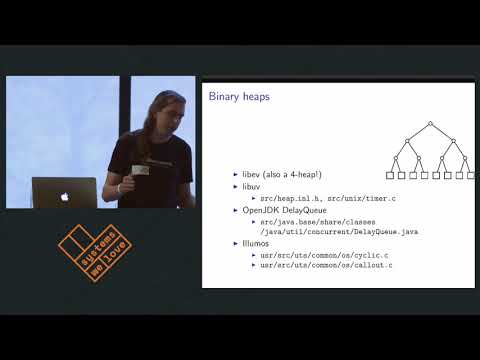
Architectural Tradeoff: 4-Ary Min-Heap vs Hierarchical Timing Wheel
Why do the Linux kernel (kernel/time/timer.c), Netty (HashedWheelTimer), and Apache Kafka (TimingWheel) use Timing Wheels for network timeouts, whereas Go's runtime (runtime/time.go) and the Linux high-resolution timer subsystem (hrtimer) use 4-ary Heaps or Red-Black Trees?
- 4-Ary Min-Heap (Go Runtime / libev): Stores
[when, period, fn, seq]entries in a flat 4-ary array. Gives exact nanosecond resolution and $O(1)$ lookup of the next deadline (timers[0].when), allowing an idle OS thread to sleep until the exact nanosecond viaepoll_wait/kqueuewith zero periodic tick wakeups. However, inserting or rescheduling costs $O(\log_4 N)$. - Single-Level Hashed Wheel (Netty): A circular array of $W$ buckets (e.g., $W = 512$, tick $\Delta t = 10\text{ ms}$). A timer expiring in $\tau$ ticks is appended in $O(1)$ to bucket $(\text{cursor} + \tau) \bmod W$ with
remainingRounds = τ / W. Cancellation is an $O(1)$ doubly-linked list unlink! However, if $\tau \gg W$, ticking through empty or high-round entries wastes CPU. - Hierarchical Timing Wheel (Kafka Purgatory / Varghese Scheme 6): Stacks multiple wheels like an odometer (e.g., Wheel 0: $20 \times 1\text{ ms}$; Wheel 1: $20 \times 20\text{ ms}$; Wheel 2: $20 \times 400\text{ ms}$). Long-horizon timers sit silently in upper wheels and cascade downward only when their coarse bucket expires. And how does Kafka avoid waking up an idle CPU every $1\text{ ms}$? By inserting only the non-empty buckets themselves (at most $20 \times 4 = 80$ buckets total!) into a tiny Java
DelayQueue(Min-Heap), so the heap size is $O(M \cdot W) = O(1)$ instead of $O(N)$!
| Timer Architecture | Start Timer | Cancel Timer (Hot Path!) | Next Expiration Wait | Production Adopters |
|---|---|---|---|---|
| Binary Min-Heap ($d = 2$) | O(log₂ N) | O(log₂ N) | O(1) Exact Sleep | Java ScheduledThreadPoolExecutor |
| 4-Ary Min-Heap + Lazy Delete | O(log₄ N) | O(1) Atomic Flag | O(1) Exact Sleep | Go runtime/time.go, libev |
| Hierarchical Timing Wheel | O(1) | O(1) Intrusive Unlink | O(1) Amortized Cascade | Linux timer_list, Netty, Envoy |
| Kafka Wheel + Bucket DelayQueue | O(1) | O(1) | O(log B) (B ≪ N buckets) | Apache Kafka DelayedOperationPurgatory |
Amortized $O(1)$ Cascade Proof for $L$-Level Hierarchical Timing Wheels
Consider an $L$-level hierarchical wheel where level $\ell \in \{0, \dots, L-1\}$ has $W$ slots and tick granularity $\Delta_\ell = \Delta_0 \cdot W^\ell$, covering a maximum horizon $T_{\max} = \Delta_0 \cdot W^L$. Assign each active timer at level $\ell$ a potential $\Phi(\text{timer}) = \ell$.
- Insertion (
startTimer): Computes the highest level $\ell < L$ where $\Delta_\ell$ divides the remaining delay, appends the timer to a doubly-linked bucket list in $O(1)$ actual time, and sets initial potential $\Phi \le L - 1 = O(1)$. - Cancellation (
stopTimer): Unlinks the intrusive list node in $O(1)$ actual time and decreases $\Phi$ by $\ell \ge 0$. - Downward Cascade (
advanceClock): Whenever a coarse bucket at level $\ell > 0$ expires and re-hashes its timers into level $\ell - 1$, each cascading timer spends $O(1)$ actual re-insertion work while its potential drops by $\Delta \Phi = -1$, paying for the cascade completely! Since $L = \lceil \log_W(T_{\max}/\Delta_0) \rceil$ is a small constant (typically $L = 4$ or $5$), every timer operation is $O(L) = O(1)$ amortized!
Compare Fredman-Tarjan Fibonacci Heaps (Φ = t(H) + 2m(H), degree-table consolidation, and cascading cuts) against Varghese-Lauck O(1) Hierarchical Timing Wheels used in Linux kernel hrtimers and Kafka.
Invariant & State
Hardware Reality: Why Go Switched from a Global 4-Heap to Per-P 4-Heaps with Lazy Status Flags
Prior to Go 1.10, all goroutines shared a single global 4-ary timer heap protected by one mutex—causing massive cross-core cache line bouncing whenever thousands of HTTP handlers called context.WithTimeout. Go first sharded into 64 heaps (Go 1.10) and then in Go 1.14 attached a 4-ary timer heap directly to each scheduler processor P, pairing it with atomic state transitions (timerWaiting $\to$ timerDeleted / timerModified). When a goroutine cancels a timer on another P, it merely flips an atomic integer in $O(1)$ without locking or mutating the remote 4-ary heap; the owning P compacts deleted entries lazily when advancing its clock!
Implementation: O(1) Intrusive Hierarchical Timing Wheel Level
// C++20: O(1) Insert / O(1) Cancel Intrusive Timing Wheel Level (Linux / Kafka Style)
#include <cstdint>
#include <array>

struct TimerNode {
    uint64_t expireMs = 0;
    TimerNode *prev = nullptr, *next = nullptr;
    bool active = false;

    // O(1) Cancellation via intrusive doubly-linked list unlink
    void cancel() noexcept {
        if (!active) return;
        if (prev) prev->next = next;
        if (next) next->prev = prev;
        prev = next = nullptr;
        active = false;
    }
};

template <size_t W = 64> // Power-of-2 wheel size for bitmask modulo
class TimingWheelLevel {
    static_assert((W & (W - 1)) == 0, "Wheel size W must be a power of 2");
    std::array<TimerNode, W> sentinels{}; // Dummy head nodes per slot
    uint64_t currentTick = 0;
    uint64_t tickShift = 0;               // tickMs = 1ULL << tickShift

public:
    explicit TimingWheelLevel(uint64_t shift = 0) : tickShift(shift) {
        for (auto& s : sentinels) s.prev = s.next = &s;
    }

    // O(1) Timer insertion into circular bucket
    void schedule(TimerNode* node, uint64_t expireMs) noexcept {
        node->cancel();
        node->expireMs = expireMs;
        size_t slot = (expireMs >> tickShift) & (W - 1);
        TimerNode* head = &sentinels[slot];
        node->next = head->next;
        node->prev = head;
        head->next->prev = node;
        head->next = node;
        node->active = true;
    }
};
Failure Modes & Adversarial Pitfalls
- Linux Kernel 2.6
cascade()Latency Spike: For two decades, the Linux kernel used a 5-level cascade wheel (tv1..tv5) that guarded both timeouts (cancelled 99.9% of the time) and periodic sleeps (which always fire). Every $256\text{ ticks}$, re-hashing an entire upper wheel bucket caused unpredictable latency spikes during softirq processing. In Linux 4.8, Thomas Gleixner redesignedtimer_listto sacrifice fine expiration accuracy on distant timeouts (increasing bucket slack at higher levels) so upper wheels never cascade downward at all! - Empty-Tick Polling Burning Battery/CPU: Never run a
whileloop that wakes up every $1\text{ ms}$ to advance a Timing Wheel on an idle system. Either track a bitmask of non-empty slots (usingstd::countr_zero/TZCNTto jump directly to the next occupied slot in $O(1)$) or push non-empty buckets into a smallDelayQueueheap like Kafka.