1. Catalan Tree Spaces & The Interval Length Topological Order
How many ways can we parenthesize a product of $n$ matrices $A_1 A_2 \cdots A_n$, construct a Binary Search Tree on $n$ sorted keys, or triangulate a convex $(n+1)$-gon? The answer to all three is the $(n-1)$-th Catalan Number:
$$C_{n-1} = \frac{1}{n}\binom{2n-2}{n-1} = \Theta\!\left(\frac{4^n}{n^{3/2}}\right)$$Because the last operation merges two contiguous sub-intervals $[i, k]$ and $[k+1, j]$ into $[i, j]$, any subproblem is uniquely identified by its pair of endpoints $(i, j)$ with $0 \le i \le j < n$—collapsing $\Theta(4^n / n^{3/2})$ trees into just $\binom{n+1}{2} = \Theta(n^2)$ distinct subproblems!
Core Invariant — Interval Length Topological Ordering ($\text{len} = j - i + 1$)
In Interval DP, state $dp[i][j]$ depends on shorter intervals $dp[i][k]$ (to the left in row $i$) and $dp[k+1][j]$ (below in column $j$). Therefore, naive row-major iteration (for i = 0..n-1: for j = i..n-1) is invalid because $dp[k+1][j]$ belongs to a later row $k+1 > i$ that hasn't been computed yet!
Two valid topological orders exist:
1. By Increasing Length: for (int len = 2; len <= n; ++len) for (int i = 0; i + len - 1 < n; ++i).
2. By Decreasing Left Endpoint: for (int i = n - 1; i >= 0; --i) for (int j = i + 1; j < n; ++j).
2. Three Isomorphic Interval DP Archetypes
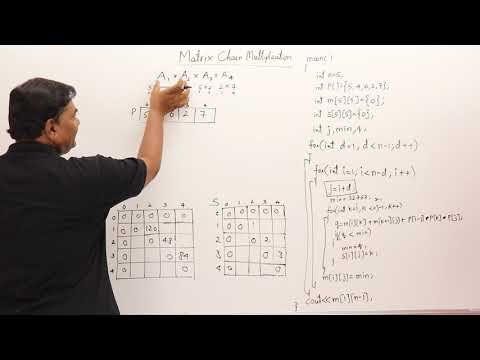
- Matrix Chain Multiplication (Dimensions $p_0 \times p_1, p_1 \times p_2, \dots, p_{n-1} \times p_n$): Multiplying matrix $A_{i..k}$ ($p_i \times p_{k+1}$) by $A_{k+1..j}$ ($p_{k+1} \times p_{j+1}$) costs $p_i p_{k+1} p_{j+1}$ scalar multiplications: $$dp[i][j] = \min_{i \le k < j} \big(dp[i][k] + dp[k+1][j] + p_i \cdot p_{k+1} \cdot p_{j+1}\big)$$
- Minimum Weight Convex Polygon Triangulation (Vertices $0..n-1$): Every diagonal-free triangulation of sub-polygon $[i..j]$ includes exactly one triangle $(i, k, j)$ on base edge $(i, j)$ for some apex $i < k < j$: $$dp[i][j] = \min_{i < k < j} \big(dp[i][k] + dp[k][j] + \text{weight}(\triangle i k j)\big)$$
- Burst Balloons / Reverse Action Trick: If popping balloon $k$ first causes $k-1$ and $k+1$ to become adjacent, the left and right subproblems are not independent! Instead, guess which balloon $k \in (i, j)$ is popped LAST inside open interval $(i, j)$: its neighbors at the moment it pops are guaranteed to be the fixed boundary balloons $i$ and $j$, making $(i, k)$ and $(k, j)$ 100% independent!
(Length < L, already finalized)"] IJ -->|"Guess split point k in [i, j-1]"| KJ["Right Sub-Interval [k+1, j]
(Length < L, already finalized)"] IK --> Merge["Combine: dp[i][k] + dp[k+1][j] + cost(i, k, j)"] KJ --> Merge
Hardware Reality — Transposing the Right Operand for Cache-Friendly $O(N^3)$ Loops
In the innermost loop for (int k = i; k < j; ++k) of dp[i][k] + dp[k+1][j], accessing dp[i][k] streams sequentially across row $i$ (stride 1, L1 cache hit), whereas accessing dp[k+1][j] jumps down column $j$ with stride $N$—causing an L1/L2 cache miss on every step when $N \ge 512$! Maintaining a transposed mirror array dpT[j][k+1] = dp[k+1][j] turns both inner-loop reads into unit-stride sequential scans, allowing the compiler to auto-vectorize the $k$-loop with AVX2 (VPMINSD/VPADDD) for a $4\times$–$6\times$ wall-clock speedup.
3. Complexity Matrix
Step through upper-triangular Interval DP diagonal wavefronts dp[i][j] by length L = 2..N, or trace Two-Pass Tree Rerooting (bottom-up subtree down[u] + top-down prefix/suffix up[u]).
Invariant & State
| Interval DP Problem | State Space $|V|$ | Transitions per State | Standard DP Time | Optimized Time (Advanced) |
|---|---|---|---|---|
| Matrix Chain Multiplication | O(N^2) | O(j - i) | O(N^3) | O(N log N) (Hu-Shing 1982) |
| Convex Polygon Triangulation | O(N^2) | O(j - i) | O(N^3) | O(N^3) |
| Optimal Binary Search Tree | O(N^2) | O(j - i) | O(N^3) | O(N^2) (Knuth Optimization) |
| Burst Balloons (Guess Last Action) | O(N^2) | O(j - i) | O(N^3) | O(N^3) |
4. Reference C++20 Implementation
#include <algorithm>
#include <cstdint>
#include <limits>
#include <vector>

// 1. Matrix Chain Multiplication with Transpose-Cache Optimization (p has size n + 1)
long long matrix_chain_multiplication(const std::vector<long long>& p) {
    const int n = static_cast<int>(p.size()) - 1;
    if (n <= 1) return 0;
    constexpr long long INF = 1LL << 60;

    // dp[i][j] = min scalar multiplications for A_i .. A_j
    // dpT[j][i] = transposed copy of dp[i][j] so inner k-loop has stride-1 on both arrays!
    std::vector<std::vector<long long>> dp(n, std::vector<long long>(n, 0));
    std::vector<std::vector<long long>> dpT(n, std::vector<long long>(n, 0));

    for (int len = 2; len <= n; ++len) {
        for (int i = 0; i + len - 1 < n; ++i) {
            const int j = i + len - 1;
            const long long outer_p = p[i] * p[j + 1];
            long long best = INF;
            for (int k = i; k < j; ++k) {
                // Both dp[i][k] and dpT[j][k + 1] are contiguous in memory along index k!
                long long cost = dp[i][k] + dpT[j][k + 1] + outer_p * p[k + 1];
                if (cost < best) best = cost;
            }
            dp[i][j] = best;
            dpT[j][i] = best;
        }
    }
    return dp[0][n - 1];
}

// 2. Burst Balloons: Guess the LAST balloon popped inside open interval (i, j)
long long max_coins_burst_balloons(const std::vector<int>& nums) {
    // Pad with virtual boundary balloons of value 1 at both ends
    std::vector<long long> a;
    a.reserve(nums.size() + 2);
    a.push_back(1);
    for (int x : nums) if (x > 0) a.push_back(x);
    a.push_back(1);

    const int m = static_cast<int>(a.size());
    std::vector<std::vector<long long>> dp(m, std::vector<long long>(m, 0));

    // len is the distance j - i between open interval boundaries (minimum 2)
    for (int len = 2; len < m; ++len) {
        for (int i = 0; i + len < m; ++i) {
            const int j = i + len;
            const long long boundary_prod = a[i] * a[j];
            long long best = 0;
            for (int k = i + 1; k < j; ++k) {
                best = std::max(best, dp[i][k] + dp[k][j] + boundary_prod * a[k]);
            }
            dp[i][j] = best;
        }
    }
    return dp[0][m - 1];
}
Production Pitfall — Guessing the First Action When Sub-Intervals Interact
Whenever removing an element $k$ causes its left and right neighbors to become adjacent and interact (as in Burst Balloons, Minimum Cost to Merge Stones, or Zuma / Remove Boxes), guessing the first element to remove destroys subproblem independence because the left and right halves will later touch across the gap! Always invert time and guess the last operation performed on the interval $[i, j]$.